YouTube SEO in 2026: How to Rank Your Videos on Google and YouTube
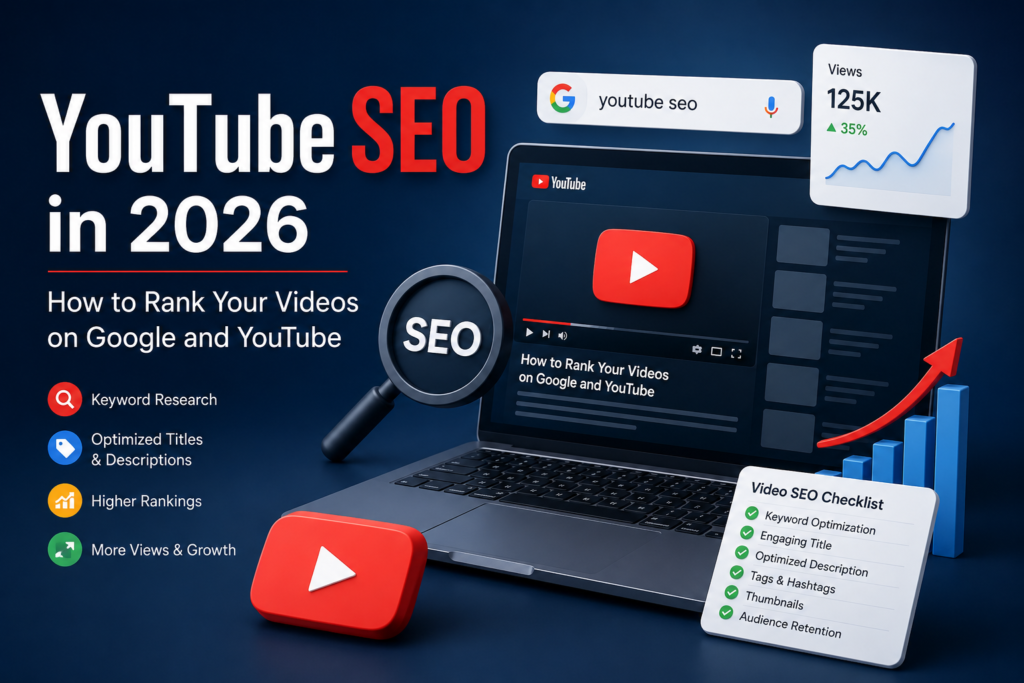
You have all of your videos made and you’re asking why do your videos not get views?You’re not the only one who has been creating videos and wondering why they’re not getting the views that you want. There are many creators that take several hours to shoot their videos, edit them and upload them to YouTube, but nothing happens. Sadly, all this good stuff isn’t enough any longer. There are also people you’ll need to have that are able to find your videos. In such a situation, you can find help by applying YouTube SEO techniques.
In 2026, YouTube SEO is completely new. It’s more intelligent; Google is continuing to publish more videos in the search results; those who do it well are the ones that are growing. It’s going to be really straightforward, simple, and with no jargon in it or fluffy anything.
What Is YouTube SEO, Really?
SEO stands for Search Engine Optimization. When we say YouTube SEO, we mean the steps you take to help YouTube (and Google) understand what your video is about — so it shows up when someone searches for that topic.
Think of it like this: YouTube’s algorithm is like a librarian. It has millions of videos to sort through. Your job is to give it clear labels, good descriptions, and signals that say “this video is genuinely helpful for people searching for X.” The better your labels, the more likely the librarian puts your video at the front of the shelf.
Importance of YouTube’s SEO for 2026.
I believe that one thing has changed in Google’s search results over the past couple of years: They are not searching for content on YouTube, they’re searching for content from YouTube. If you search Google about the leaky faucet or best budget phone 2026, you’ll see the results on the first page.
This implies your video will be discovered two times, which is if somebody searches for it on YouTube as well as Google. That’s a huge deal. With the right type of YouTube SEO, you can double-down the exposure you’re able to achieve for the same content.
Step 1: Find the Right Keywords (Before You Even Film)
The last thing creators want to do is to think of the keywords after they have thought up an idea for a video. Flip that around. Move first to where they’d like to move.
The easiest method of finding keywords is to:
- Now enter the subject you want to on the Google search bar and note down the highlighted key phrases – all these are actual queries being made by users of Google.
- Using free platforms such as Google Trends, VidIQ or TubeBuddy to check search volume and competition.
- Check out videos in your niche that are successful – what are some of the keywords that are in the title?
- Use a variety of words (like YouTube SEO) and more specific phrases (like, YouTube SEO for small channels 2026).
As you’re just starting out, follow particular keywords. They don’t have the competition and individuals searching for very specific products will likely be more likely to watch a full video. Once you get bigger in the years to come, you may get to target bigger keywords.
Step 2: Propose a title which is friendly to humans as well as to algorithms.
Your YouTube title is by far the most important aspect of the YouTube property. It must do two things: First put the keyword in the copy in a natural way, and, second, get the click of a human being.
YouTube SEO Tutorial is good, but YouTube SEO in 2026: The Simple Strategy That Actually Works is better because it gives you the year (so you know it is updated), as well as a CTA in the copy, that includes the keyword.
Step 3: Nail Your Video Description
Typically, only two sentences are used in the description and it’s done. This is a possible missed opportunity. Your description is the place you’ll detail YouTube and Google what your video is about.
Try to write 200-300 words (or more). Use Synonyms in 1st line, use the main word in 1st line. Do not force keywords in, forget to write as you would speak to a friend about the video. Include time, links to other pages and call to action (channel subscription, comments, etc.).
If you have a good video description, it will also be reflected in the Google search and if it happens to be a search that wasn’t done on there, it is going to be easier for your video to be discovered!
Step 4: Tags Still Matter — But Not as Much as Before
YouTube Tags used to be of significant importance in YouTube SEO. They’re not as important these days, but they still assist particularly in confirming the content of your video and spelling variations of your keyword.
There will be 5-10 tags needed per video. You want to write your key phrase first, followed by some more generic phrases that may be relevant and then a few long tail phrases. Do not use tags that are doing nothing but a “game” — YouTube will be clever enough to work this out and it could cause an impact on ranking!
Step 5: Thumbnails Are SEO Too
In this step students create thumbnails. But, here is an interesting fact that not many people are aware of: Your thumbnail will indirectly help YouTube SEO: via CTR (Click Through Rate). If two videos are bidding on the same keywords, the top video will appear on the SERP as long as it gets a higher click count as the result of the bid. However, what is the driving force behind the clicks? Thumbnails.
Clear, bold (if bold text is used) and prominent in any size are good thumbnails. Examine the successful videos in your niche and determine the types of videos which perform well for making the videos on your thumbnails. Afterwards, click on the one you think of and want to view, that is a little different from the other row of results that are presented.
Step 6: Watch Time and Viewer Satisfaction
YouTube’s algorithm gives rewards to videos that do not let users from scrolling off the page. This is denoted as watch time and audience retention. If your video doesn’t hold users’ attention for at least 10 seconds and they go back, viewers recognize that your video was not as informative as they had thought.
Whenever then how do you keep people’s attention? Hook them fast. In the initial 30 seconds, record their learning objective(s), and how the video you are displaying will affect their learning. Avoid any long intros, filler or sponsor reads at the start. Quickly reach the value.
Don’t miss the average viewing times provided by the YouTube Analytics tab in your YouTube account. In all videos, the people are dropping off in that segment, or fall off-topic and the segment is too slow. Fix this mistake in the second one!
Step 7: Chapters, Captions and Cards
Here are 3 little but significant effort BIG YouTube SEO wins:
- Thanks to the labels on the site containing keywords and timestamps, using Chapters on YouTube algorithm will assist it to better understand the structure of your video. It also enables viewers to easily navigate the site and keeps them engaged for longer.
- If you are using a transcript or YouTube generates a closed caption, it will do so automatically and correct any mistakes (if you find any). Captions are added text to be added to the index which helps the algorithm to be found online.
- Cards and End Screens — These tie to other content in your channel that will help to grow channel watch time. A high ranking signal signals a high amount of time on a channel.
Step 8: Getting Your Videos to Rank on Google (Not Just YouTube)
Here’s where many creators lose points for visibility. Google sorts the search results according to their “video intent” – Google thinks the video format is the best to answer that question.
Anything that has a “how-to tutorial,” or a “list,” or a product review will seldom come back with any other kind of result but a video from Google. Remember if it’s a good, pure keyword to video, title and description should say as such, if it is how to tie a tie or best laptops under 50,000 rupees, then title and description should also convey that.
You may also want to embed your YouTube video on a blog post that you make on your website. Google has two pages on the search results page associated with the blog post (and video) and indexes the blog post itself as well as the video.
Step 9: Consistency Beats Perfection
However, the one thing that never changes is YouTube SEO – the websites that upload regularly grow faster than the ones which fail to upload. More active channels will be listened to by YouTube. No need to post every day, even once a week is effective, but it is important to post on a regular basis.
Each of the videos will be another means for bringing channel followers or viewership to your channel. The more doors you are installing, the more people moving about.The more doors you construct, the more walk throughs.
Final Thoughts
In YouTube SEO 2026, it’s not about the algorithm. As a digital marketer, YouTube SEO in 2026 is not about teaching creators how to manipulate the YouTube algorithm. It’s about focusing on content creation through a people-first approach and helping the right audience discover valuable content.
Utilize a search term that your audience is searching for. Create engaging title that gets clicks. Provide them with a video that keeps that promise. Create a description, caption and chapter for your video. Don’t forget to come back and here you are.
It isn’t necessarily the case that the most creative film makers are the ones that are winners on YouTube. It’s they who know how to utilize YouTube SEO as an ongoing approach. Now you do too. I have to go and make something that will be found.